













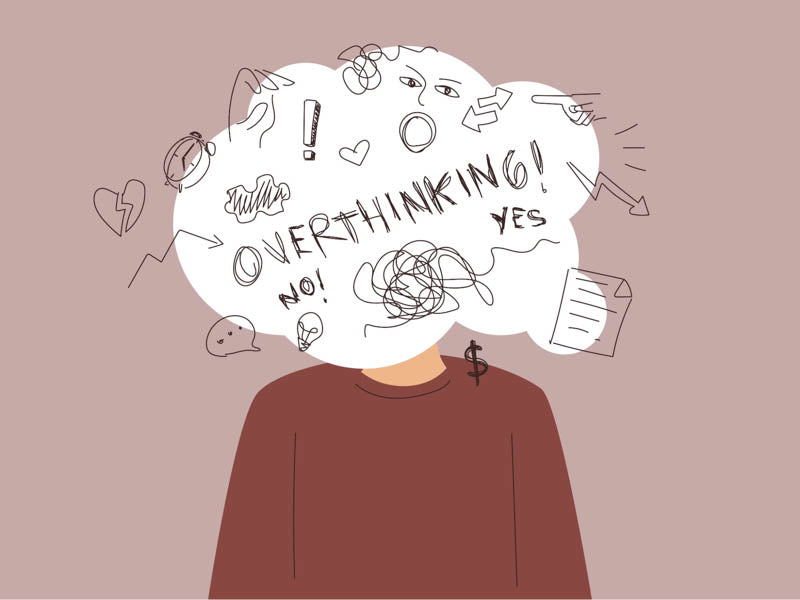
In the fast-paced modern life, many people often fall into a state of overthinking, causing their minds to constantly spin with anxiety, stress, and difficulty concentrating. So, what is overthinking, why are we prone to it, and how can we escape this endless "spiral" of thoughts? Let's explore with Ru9 in the article below!

1. What is overthinking?
1.1. Definition of the overthinking syndrome
What is overthinking? Overthinking is the phenomenon where a person thinks too much about a certain issue, even if it's not serious.
The tendency to repeatedly dwell on thoughts or over-analyze past or future situations causes overthinkers to constantly torment themselves. This leads to persistent stress, anxiety, difficulty concentrating, and reduced work performance and quality of life.
This condition can affect anyone, regardless of age or gender. The causes of overthinking are diverse, often stemming from psychological factors such as prolonged stress, mental trauma, chronic anxiety, or adult attention deficit hyperactivity disorder (ADHD).

1.2. Distinguishing overthinking syndrome from observation skills
Observation skills are understood as the ability to carefully perceive objects and phenomena around us to analyze and understand an event, an issue, or a situation. A person with good observation skills can intelligently avoid potential risks and make wise decisions.
Conversely, an overthinker will only focus on amplifying the impact of a trivial detail instead of looking at the big picture. This can easily lead them into a spiral of anxiety, making them prone to mistakes and even becoming timid and hesitant.
1.3. Is overthinking considered a medical condition?
In reality, medical professionals would not call it "overthinking disease." This is because it is not diagnosed as a separate mental illness in medical manuals. Instead, it is commonly known as "overthinking syndrome," as it is a core symptom that can lead to conditions such as depression, obsessive-compulsive disorder (OCD), attention deficit hyperactivity disorder (ADHD), or anxiety disorders.

1.4. Classification of common overthinking symptoms
- Overthinking about the past: Often occurs when you think excessively about events or situations that have already happened and ended in the past. You might feel immense regret or guilt about actions or decisions made, even if they didn't cause any serious impact. Repeating these situations in your head can lead to negative thinking and make you doubt yourself.
- Overthinking about the future: Often seen when you excessively imagine possibilities that might occur if you do something. This type of overthinking largely limits your decision-making ability, while also causing prolonged stress and affecting your quality of life.
2. What are the signs of overthinking syndrome?
2.1. Manifestations of an overthinker
- Exaggerating the impact of an event: One of the clearest signs of overthinking is constantly thinking, analyzing, and self-interpreting everything, even the smallest details. These thoughts might be fleeting, but they can also recur in your mind, making it difficult to control your thought process.
- Excessively questioning oneself: People who overthink often doubt their decisions and actions, and fear making mistakes. They tend to put themselves in too many situations and then worry about their own capabilities.
- Searching for hidden meanings behind everything: They tend to pay excessive attention to trivial details, trying to interpret the emotions or thoughts of others, even if it's just a casual joke.
- Persistent physical fatigue: This condition can sometimes last even when you are working, playing, or resting, exhausting both your body and mind.
- Experiencing medical conditions: Thinking too much can also lead to problems such as insomnia, loss of appetite, difficulty concentrating, and a constant feeling of exhaustion.
2.2. David A. Clark's overthinking test

Questionnaire: Please read carefully and answer honestly each of the following questions to assess your tendency to overthink:
- Do you often find yourself sitting and thinking aimlessly, without a clear purpose?
- Do you often wonder why you have such thoughts?
- Do you try to analyze or uncover the deeper reasons behind those thoughts?
- When you feel sad, do you tend to think more?
- Are you curious to understand how your brain works?
- Do you believe that controlling your thoughts is important?
- Are you critical or annoyed by spontaneous thoughts that you don't want?
- Do you find it difficult to control your own thought streams?
Scoring: Rate how true each statement is for you using the following scale:
- 0: Not true at all
- 1: Partially true or sometimes true
- 2: Quite true, true most of the time
- 3: Very true, true almost all the time
Results: After answering, sum up the points for all 8 questions to determine your level of overthinking:
- 0 – 7 points: Normal – you show almost no signs of overthinking.
- 8 – 14 points: Mild level – a tendency to overthink but not yet serious.
- 15 – 21 points: Moderate level – clear overthinking symptoms, you should start making adjustments.
- 22 points or more: Severe level – you may be experiencing real difficulties with overthinking and should consider seeking help from a psychologist or doctor.
If you score in the higher range, proactively seek help from experts or psychologists. They can guide you through psychological therapy, relaxation techniques, and stress management methods to help reduce the impact of overthinking symptoms in your daily life.
3. Impact of overthinking on surrounding relationships
Overthinking can become a silent "poison" in relationships. When you overthink, doubt and anxiety can easily creep in, gradually eroding trust and understanding.
In love, for example, overthinkers often tend to overanalyze every word or message from their partner. A brief response can be interpreted as coldness or indifference. These negative thoughts strain the relationship, leading to misunderstandings and arguments, making both individuals feel tired and distant over time.

4. Consequences of prolonged overthinking
- Mental exhaustion and negative mood: Those affected often criticize and torment themselves, falling into a loop of negative thoughts, making their emotions dark and pessimistic.
- Risk of mental disorders: Overthinking can lead to depression, anxiety, sleep disorders, eating disorders, or even substance and alcohol dependence.
- Difficulty recovering from mental trauma: Overthinking makes it difficult for those affected to let go of the past, making them prone to being haunted by negative experiences and struggling to regain emotional balance.
- Impact on relationships: Excessive doubt and worry make them prone to misunderstandings, lack of trust, and distance from those around them.
- Reduced creativity and concentration: Research shows that overthinking overloads the prefrontal cortex, leading to impaired creative thinking and problem-solving skills.
- Negative impact on physical health: Prolonged stress can cause fatigue, headaches, loss of appetite, or digestive problems.
5. Steps to overcome overthinking symptoms
5.1. Recognizing that you are overthinking
According to clinical psychologist Helen Odessky, many people often confuse overthinking with thinking to find solutions. In fact, when you focus on finding a solution, that is a positive thought process aimed at solving a problem. Conversely, overthinking is when the mind constantly dwells on worries and negative scenarios without reaching a concrete conclusion.
Furthermore, overthinking is also easily confused with self-reflection. Self-reflection is a skill that helps you look back at yourself positively, learn from experiences, and find new directions for growth without self-judgment or blame. Overthinking, on the other hand, causes you to get bogged down in negative self-assessments, gradually losing balance and control over your thoughts.
5.2. Understanding the causes of overthinking
Past regrets about decisions or self-doubt can sometimes lead to stress and excessive thinking. Over time, this not only erodes your mental health but also affects your physical health, manifesting as insomnia, headaches, fatigue, or loss of appetite.

To break free from this cycle, you need to identify the root causes of your negative thinking and learn to adjust your emotional responses. By understanding what makes you prone to overthinking, you can proactively control your thoughts, or at least recognize them early so they don't affect you too deeply.
5.3. Shifting to a more positive perspective
It's important to recognize that the mind often tends to focus on the negative aspects of a problem, because the brain is programmed to warn and protect against dangers.
However, you can completely change your perception by focusing on the positive aspects of a situation. When you adjust this perspective, you will see the problem through a new lens, making it easier to find effective and creative solutions.
6. Methods to help prevent excessive overthinking
Some effective ways to overcome overthinking: Positively distract your mind, set a "worry time frame," practice Mindfulness, keep a journal, improve physical health, talk and seek help, learn to love yourself.
6.1. Positively distracting your mind
Sitting still and trying not to think about anything is often ineffective and can sometimes prolong negative thoughts. Instead, you can redirect your focus to other activities:
Physical activity: Walking, jogging, practicing yoga, or dancing... activities that make your heart beat faster and your body move will help dissipate stressful energy.
Creative or crafting activities: Cooking new dishes, gardening, painting, playing a musical instrument... helps your mind stay busy in a positive direction.
Listening to podcasts or audiobooks: Focusing on a new story or topic helps your mind avoid getting caught in a loop of circular thoughts.
6.2. Limiting "worry time frames"
It may sound strange, but the technique of setting a "worry time frame" is very effective. You can dedicate 15–20 minutes each day, for example from 5:00 PM to 5:20 PM, solely to thinking and worrying about anything you want.
If anxious thoughts appear outside of this time, write them down and tell yourself: "I'll save this thought for 5 PM." By doing this consistently, you will gradually learn to control your worries instead of letting them dominate your mind.
6.3. Practicing Mindfulness

Mindfulness is the art of living fully in the present moment and an effective method to reduce overthinking.
Meditation and focusing on breath: Spend 5–10 minutes each day sitting still, closing your eyes, and fully focusing on your breath – feeling the air enter and leave. When other thoughts arise, simply acknowledge them and gently bring your attention back to your breath.
5-4-3-2-1 technique: When feeling stressed or overwhelmed, stop and observe:
- 5 things you can see
- 4 things you can feel with touch
- 3 things you can hear
- 2 things you can smell
1 thing you can taste
This technique helps you connect with the present moment instantly through your senses, calming your mind and reducing the loop of negative thoughts.
6.4. Keeping a journal
Take a notebook and write down all the thoughts running through your head, without organizing or judging them. Pouring your mind onto paper helps reduce stress, clarify troubling issues, and make them more manageable.
6.5. Improving physical health
Taking care of your body is a way to nurture a strong mind. Here are some ways to care for your body:
Get enough deep sleep: Ensure quality rest time for your body and mind to recover.
Eat healthily: Prioritize fresh, nutritionally balanced foods and limit sugar, processed foods, or caffeine.
Exercise regularly: Regular exercise is not only good for physical health but also helps reduce stress and improve mood.
6.6. Talking and seeking help
You don't have to face overthinking alone. Try these methods:
Share with a trusted person: Talking to close friends or family helps you gain new perspectives and empathy.
Consult a mental health professional: If overthinking is seriously affecting your life, seeking a therapist or psychologist is an important step to receive professional guidance and support.

6.7. Learning to love yourself
Finally, practice self-love and self-care. Remember that overthinking is normal, and you don't have to endure it alone. Learn to forgive yourself and allow yourself to grow and change. Building a positive mental environment is key to overcoming excessive thinking and maintaining peace of mind.
Conclusion
Above is basic information on what overthinking is and how to avoid or escape the overthinking syndrome. By recognizing negative thoughts, practicing methods like mindfulness, exercise, journaling, or seeking support, you can gradually control your mind, improve your thinking and spirit. Be patient and start with small steps, moving day by day towards a peaceful life free from the spiral of excessive thinking.
Refer to other terms:
- What is Slay? Decoding the literal and figurative meanings of the word Slay
- What is Vibe? Explaining the meaning and usage of different types of vibes
- What is Bach Nguyet Quang? Exploring its origin, meaning, and influence


