Which mattress is right for you?

Which mattress is right for you?

Mattress selection Quiz

Frequently Asked Questions

No matching questions found.

A firm, flat mattress is safest. A surface that's too soft sinks around the baby's face, raising the risk of airway obstruction, so international sleep-safety guidelines agree: firm, flat, snugly fit to the crib, with no gap wider than 2cm. Rubaby's baby mattresses are optimized around this principle and are CertiPUR-US® certified.

Babies under 12 months shouldn't use a pillow. At this stage, a baby's neck is nearly straight and hasn't developed an adult-like curve, so a pillow provides no support benefit and only adds a soft object to the sleep space. The only exception is a controlled anti-flat-head pillow, used while the baby is awake and supervised.

SIDS is the sudden, unexplained death of a baby under 12 months during sleep. Widely agreed risk-reduction measures: place baby on their back to sleep, use a firm flat mattress, keep pillows, thick blankets, stuffed toys, and crib bumpers out of the crib, room-share without bed-sharing, and keep the room cool and ventilated.

The safety guideline is room-sharing without bed-sharing for the first 6–12 months. Room-sharing makes nighttime feeding and monitoring easier; bed-sharing raises the risk of the baby being rolled onto, trapped between the mattress and wall, or smothered by adult bedding. A bedside bassinet balances both.

No. Babies under 12 months should be placed on their back for every sleep, including daytime naps — this is the most strongly evidence-backed measure for reducing SIDS risk. Once a baby can roll both ways and turn their head confidently on their own, you don't need to flip them back, but always start them on their back.

The crib should only have: a firm mattress snugly fit to the crib and one fitted sheet. It shouldn't have: pillows, thick blankets, stuffed toys, crib bumpers, loose cloths, or hanging cords. The easy rule is a bare crib — every loose soft item is a risk for a baby under 12 months. For warmth, use a sleep sack instead of a blanket.

Stop swaddling once your baby shows signs of rolling over, usually around 2–4 months. A swaddled baby who rolls onto their stomach can't use their arms to push themselves up — this is the point swaddling shifts from safe to risky. Transition gradually to a sleep sack so the baby still feels held while their arms stay free.

A baby's bedroom should be around 20–22°C. Babies regulate body temperature less well than adults, and overheating is a factor that raises SIDS risk, so the rule is dressing baby in exactly one more layer than an adult — no more. Check by feeling the back of their neck: warm is fine, sweaty means too hot.

Check the back of the neck first — if it's damp with sweat, baby is too warm. Remove a layer of clothing, lower the room to 20-22°C, and skip a hat indoors. Avoid pointing a fan directly at the baby. A Rubaby cooling mat on the mattress helps dissipate heat from the back, where babies retain the most heat.

Yes. Newborns wet and spit up frequently, and liquid soaking into foam is very hard to dry out and creates a breeding ground for mold. A washable waterproof cover keeps the mattress clean inside while staying easy to clean. Rubaby offers a Baby Mattress Waterproof Cover from 395,100 VND and a Waterproof Sheet from 161,700 VND.

Hotels in Vietnam typically use pocket-spring or hybrid mattresses, chosen for durability under high turnover and neutral firmness that suits most guests. International chains often specify their own bedding programmes. Ru9 supplies the hospitality segment through Ru9 Professional, its business-to-business line for hotels, resorts and serviced apartments.

Bulk mattress purchasing in Vietnam usually runs through manufacturers' business-to-business divisions rather than retail channels, which allows custom sizing, volume pricing and phased delivery. Ru9 serves this segment through Ru9 Professional. Ask about foam density specifications, certification documents, warranty terms for commercial use and replacement cycles before comparing quotes.

Boutique hotels typically want a neutral medium-firm feel that suits the widest range of guests — around 8.0 on a 10-point scale — with pocket springs or a hybrid for durability and edge support. Specify foam density and certification in the contract, and plan a replacement cycle of five to seven years under commercial use.

Hotel mattresses are generally replaced every five to seven years, shorter than the 7-10 years typical of home use, because occupancy turnover compresses the wear. Higher-occupancy properties replace at the shorter end. Using a protector on every bed and rotating mattresses quarterly measurably extends usable life.

Yes. Vietnam is an established manufacturing base for furniture and bedding exports, including foam and spring mattresses. Some domestic brands manufacture locally for both home and export markets. If sourcing, ask for material certifications such as CertiPUR-US® and OEKO-TEX®, plus factory audit documentation, rather than relying on country of origin alone.

For an Airbnb, prioritise durability and neutral firmness over personal preference — around 8.0 on a 10-point scale suits the widest range of guests. Add a washable waterproof protector on every bed, since guest turnover makes spills inevitable. A 15-20cm foam mattress like the Ru9 Nest or Original balances cost and guest comfort.

Positional flat head is common and usually correctable. The three most effective steps: alternate which way your baby's head faces each time you lay them down, increase supervised tummy time while awake, and limit time in car seats and bouncers. If the flattening is still pronounced after four months, have a doctor assess it.

The Rubaby anti-flat-head pillow uses a ventilated memory foam core with a concave zone that distributes head and neck weight evenly, certified to OEKO-TEX® 100 and CertiPUR-US®. But it supports rather than replaces the two measures with the strongest evidence — alternating head position each sleep, and tummy time. For babies under 12 months, use it during supervised awake time.

Most positional flat head improves over 6-12 months as babies begin sitting, crawling and spending less time lying down. Early intervention works better — before four months the skull is at its most malleable. If there is no improvement by four to six months, or the flattening is pronounced, have a paediatrician assess it.

Yes, and this is exactly why safe-sleep guidance specifies a firm mattress. An overly soft surface lets the body sink unevenly so the spine is not supported in the right position, and it raises the risk of restricted breathing if the baby's face turns into it. For newborns a firm flat mattress is a minimum standard, not a preference.

Tummy time is supervised awake time spent lying on the stomach. It builds neck, shoulder and back strength and reduces flat head. You can start in the first days after birth with 1-2 minutes at a time, several times a day, building toward about 60 minutes daily in total by three months.

A head-turn preference is common in the first weeks. Address it actively: lay the baby with their head turned left for one sleep and right for the next, and move toys and your position so they have to turn the other way. If your baby cannot turn to one side at all, have a doctor check for torticollis.

OEKO-TEX® Standard 100 is an independent certification confirming a textile contains no harmful substances above set limits. For baby products, look specifically for Class 1 — the strictest grade, applied to items in direct contact with the skin of children under three. Rubaby products carry this certification.

CertiPUR-US® is an independent foam certification with six criteria: no PBDE, TDCPP or TCEP flame retardants, no mercury, lead or heavy metals, no formaldehyde, no phthalates, VOC emissions under 0.5 ppm, and ozone-safe manufacturing. Foam is re-tested randomly each year. The Rubaby baby mattress carries it, with an OEKO-TEX® certified bamboo-fibre cover.

Muslin is a loosely woven, multi-layer cotton fabric that softens with each wash and breathes exceptionally well — both useful for a baby's skin and for Vietnam's hot, humid climate. The open weave lets air circulate, reducing the risk of overheating. The Rubaby muslin blanket is 335,200 VND.

GOTS certifies organic cotton, requiring at least 95% organic fibre and controlling the whole production chain including chemical use and labour conditions. The main practical difference from conventional cotton is no synthetic pesticides and restricted processing chemicals. For sensitive baby skin it is worth considering alongside OEKO-TEX® certification.

Yes, wash it first. Manufacturing, packaging and shipping leave lint, sizing agents and finishing chemical residues, and one wash removes most of it. Use a detergent made for baby clothes, skip strongly fragranced fabric softener, and wash separately from adult laundry for the first few months.

The smell is VOCs off-gassing from manufacturing and normally clears within 24-72 hours in a ventilated room. Unpack the mattress, air the room, and wait until the smell has gone before your baby sleeps on it. CertiPUR-US® certification caps VOC emissions at 0.5 ppm — that is the thing to check, rather than the smell.

A quality foam mattress lasts 7-10 years, and foam density decides that more than thickness does. Budget foam at 25-30 kg/m³ starts sagging after 6-12 months. The Ru9 Fit uses 40 kg/m³ HR foam with a resilience index of at least 55% under ASTM D3574, holding form 3-5 years. Higher models carry 5-10 year warranties depending on product.

Every foam mattress softens slightly over time — Ru9 classes gradual softening as fair wear and tear rather than a defect. The specific threshold that counts as a warranty claim is sagging beyond 10% of the mattress height, measured on a flat surface with nothing resting on it. That is a figure you can measure and check yourself.

HR foam springs back quickly and works as a supportive base layer. Memory foam responds slowly, softening with body heat to hug the body and relieve pressure. Gel foam adds gel to memory foam to cut heat retention. Graphene memory foam goes further, drawing heat away from contact points so it won't soften into a permanent soft spot.

Cooling gel works, but it saturates with heat after 1–2 hours, after which the effect fades. Two more lasting approaches: mixing graphene directly into memory foam to draw heat from contact points and disperse it across the layer (Original Pro), or open-cell foam that lets air circulate continuously (Air).

Independent pocket springs are a spring system where each coil is individually wrapped in a fabric pocket, so they compress independently of each other. The result: vibration doesn't travel sideways — your partner can shift at 3am and you won't notice. This is the base layer of the Hybrid mattress, paired with foam on top.

A hybrid mattress combines independent pocket springs below with foam on top — taking bounce, breathability, and edge support from the springs, and body-hugging comfort from the foam. Ru9's Hybrid is 25cm thick, with a PU foam edge protecting the springs and a swappable Comfort Top in Medium and Firm. Suits couples, hot sleepers, and people over 80kg.

Not better — different. Natural rubber bounces more, breathes better, and lasts longer, but it's heavier, pricier, and doesn't hug the body as closely. Memory foam contours to the body's curve and isolates motion better. Hot sleepers who like bounce suit latex; side sleepers needing shoulder and hip pressure relief suit memory foam.

A breathable mattress creates a path for air to pass through the mattress body, not just cool the surface. Ru9's Air mattress uses a 3cm open-cell AirCell foam™ core, achieving a breathability rating of 2,215.11 L/d·m²·min — 4.58x that of ordinary foam — paired with a vented HD base that channels air out the sides. Total thickness: 18cm.

More layers aren't automatically better — what matters is each layer doing one job. Ru9's Nest has 2 layers, Original has 3, and Original Pro has 5, including a removable 5cm topper plus a 20cm base. The Air splits 3 foam layers by airflow: 3cm AirCell, 4cm HR foam, 10cm PU base. Clear structure matters more than layer count.

3-zone support divides the mattress into three firmness zones — shoulders, back, legs. The shoulders and hips need enough give for natural contact; the lower back needs firm support so it doesn't sag. Ru9 uses this in the Original Pro's Contour 3-Zone and the Air's 3-Zone Zonal Support™ system.

New foam smell is VOCs off-gassing from manufacturing, usually gone within 24–72 hours in a ventilated room. Smell doesn't equal toxicity — certification is what to check instead. Ru9's foam is CertiPUR-US® certified: no PBDE, TDCPP, or TCEP flame retardants; no mercury, lead, or heavy metals; no formaldehyde; no phthalates; VOC emissions under 0.5 ppm.

Tencel is made from wood fiber, wicks moisture best, and feels cool to the touch — suited to hot, humid climates. Cotton sateen has a satin weave, so it's soft with a slight sheen but retains more heat. Percale has an even plain weave, thin, crisp, and the most breathable of the three. For Vietnamese summers, Tencel and percale are the more comfortable picks.

Usually yes — dense foam retains body heat, while springs create air pockets for circulation. But the gap narrows when foam has an open-cell structure or vented channels. Ru9's Air mattress reaches 2,215.11 L/d·m²·min, far above typical foam. Compare specific breathability structures rather than just foam versus springs.

A compressed cotton mattress (nệm bông ép) is densely packed cotton fibre — very firm, cheap, but with no resilience, so it develops a permanent body-shaped hollow within two to three years. Foam springs back after each use and contours to the body. If you like the firm feel of bông ép, choose foam at 8.0 firmness or above.

A sagged compressed cotton mattress usually causes back pain because the surface has hollowed to your body shape and no longer keeps the spine aligned. If you want to keep that familiar firm feel, choose 8.0 firmness or above: the Ru9 Nest 15cm (8.0), Original Pro Firm (8.5) or Hybrid Firm (9.0). Laying a topper over an already hollowed mattress does not solve the problem.

No. 'Cao su non' is a Vietnamese commercial name for polyurethane foam, not natural latex tapped from rubber trees. Genuine natural latex is heavier, bouncier, considerably more expensive, and is normally specified as Dunlop or Talalay. When buying, ask directly whether the material is PU foam or latex rather than relying on the label.

Density and certification. Budget foam sold in Vietnam is typically 25-30 kg/m³ and starts sagging within 6-12 months. The Ru9 Fit uses 40 kg/m³ HR foam with a resilience index of at least 55% under ASTM D3574. All Ru9 foam is CertiPUR-US® certified, capped at 0.5 ppm VOC emissions and randomly re-tested each year.

Ru9 gives you a 100-night at-home trial, recommending at least 14 nights before deciding. Conditions: purchased from ru9.vn, a showroom, or an official channel (Shopee, Lazada, TikTok Shop, and Tiki orders follow that marketplace's own policy), unboxed within 30 days, and the returned product must be intact, clean, with no yellowing or mold — so use a mattress protector.

Warranty length varies by product. The Original Pro (base), Hybrid (base), Original 25cm, and Original Lite carry a 10-year warranty. The Nest carries 5 years. Topper lines and the Rubaby mattress carry 1 year. The Niu Pillow and Body Pillow carry 1 year. Cloud Toppers, Cloud Pillows, blankets, and fabric products have no warranty and follow the manufacturer's defect-exchange policy.

Yes, within the 100-night trial — but shipping fees apply. For orders in Ho Chi Minh City and Hanoi: 350,000 VND to exchange for another product, 700,000 VND for a full return. Other provinces: 400,000 VND to exchange, 800,000 VND to return. Ru9 covers the fee if the product has a manufacturing defect or you're upgrading to a higher-value item. Custom-sized mattresses aren't eligible.

Yes, Ru9 delivers throughout Vietnam. Mattresses are vacuum-compressed and boxed, so they clear narrow stairwells and lifts. Delivery within the main cities is typically 2-5 working days, longer for distant provinces. After unboxing, allow 24-72 hours for the mattress to reach full shape before judging how it feels.

Delivery within Ho Chi Minh City and Hanoi usually takes 2–5 business days from order confirmation. Other provinces need extra time depending on the shipping route. Once received, let the mattress expand for 24–72 hours before sleeping on it — the 100-night trial period starts from your delivery date.

Ru9 offers free shipping on customer deliveries. Fees only apply if you exchange or return during the trial period: 350,000 VND to exchange and 700,000 VND to return in Ho Chi Minh City and Hanoi; 400,000 VND to exchange and 800,000 VND to return in other provinces. Ru9 covers the fee for manufacturing defects or upgrades to a higher-value product.

Ru9 has 3 showrooms in Ho Chi Minh City and Hanoi, where you can test the full mattress range and get advice based on your weight and sleep position. Addresses and hours are updated at ru9.vn/pages/stores. If you're not near a showroom, the 100-night at-home trial gives a far more realistic test than 10 minutes in a store.

Mattresses returned during the 100-night trial aren't resold as new. Ru9 handles them through its community responsibility program, donating usable mattresses to social organizations or recycling the materials rather than returning them to inventory. Updates on this program are posted at ru9.vn/pages/trach-nhiem-cong-dong-csr.

The warranty covers manufacturing defects: foam layers separating, and sagging beyond 10% of the mattress's height when placed on a flat surface with no force applied. For the Hybrid's base, broken or shifted pocket springs are also covered. It doesn't cover normal wear — gradual softening, fabric pilling or scuffing — or liquid damage.

Check warranty status at ru9.vn/pages/tra-cuu-bao-hanh using the phone number or order code from your purchase. To submit a new warranty claim, use the form at ru9.vn/pages/yeu-cau-bao-hanh — you will need photographs of the mattress condition and information on whether it has been exposed to liquid.

Ru9 delivers boxed mattresses to your home and helps bring them into the room. Mattresses are vacuum-compressed, so you unroll and let them expand for 24–72 hours yourself — no complex setup needed. Old-mattress removal depends on area and timing — confirm with a consultant via Zalo or hotline before ordering.

Ru9 offers a 100-night home trial, which is uncommon in Vietnam where most retailers offer showroom testing only. It applies to mattresses bought through ru9.vn, Ru9 showrooms and official channels. Some other direct-to-consumer brands offer shorter trial windows; multi-brand retailers generally do not offer home trials at all.

A foam mattress is ideal if you want a soft, body-hugging feel, motion isolation, and won't wake up when your partner shifts position. Pocket-spring mattresses suit you if you want more bounce, breathability, and edge support. Ru9's Hybrid mattress combines both: pocket springs below, foam on top, 25cm thick.

Memory foam is viscoelastic foam that softens with body heat, cradling your spine's curve and spreading pressure at the shoulders and hips. It suits side sleepers and people with joint pain. Traditional memory foam can trap heat, though, so look for a cooling-gel or breathable version, like Ru9's Original or Air mattress.

Three factors decide it: body weight, sleeping position and how hot you sleep. Heavier bodies need higher firmness so the spine does not bow; side sleepers need a surface that lets the shoulder and hip sink in. Ru9 consults using a 9-dimension framework, and the Sleep Match Quiz on ru9.vn asks five questions to point you to the right model.

Most Vietnamese adults suit 7.5-8.5 on a 10-point scale — medium-firm. That range balances spinal support against comfort for people between 55 and 90kg. The Ru9 range sits inside it: the Fit at 7.0, the Original and Air at 7.5, the Nest at 8.0, and the Hybrid Firm at 9.0.

People over 80kg should choose a firmness of 8.0 or higher and a mattress at least 20cm thick, so the support layer underneath doesn't fully compress. Ru9's Original Pro Firm (firmness 8.5, 25cm, 5 foam layers with 3-zone support) or the Hybrid Firm (9.0, pocket springs) suit this weight range.

People under 55kg usually do better on a softer surface, because a light body does not compress a firm mattress enough for it to follow the spine's curve — leaving the lower back unsupported and aching. Firmness of 7.0-7.5 is a sensible starting point. In the Ru9 range, the Fit (7.0) or Original (7.5) suit better than the Nest (8.0).

Side sleepers should choose a firmness of around 7.0–7.5, soft enough for the shoulders and hips to sink in while keeping the spine aligned when viewed from the front. A mattress that's too firm concentrates pressure on the shoulder joint. Ru9's Original (7.5) and Air (7.5) suit this position; pair with a 10–12cm pillow.

Stomach sleeping twists the neck 90 degrees all night and pushes the lower back into an arch, usually causing neck pain and lower-back soreness. If you can't change position, choose a firmer mattress (8.5 or higher) so the hips don't sink too deep, and use a very thin pillow or none at all. Ru9's Original Pro Firm suits this.

Ru9's Original Pro and Hybrid solve this directly: the Comfort Top layer attaches to the base with a zipper, comes in Medium and Firm, and you can swap firmness within the first 100 nights. Another option is a Hybrid with independent pocket springs for motion isolation, or adding a topper on the softer sleeper's side.

Four things: your weight and sleeping position, which decide firmness; the size of your existing bed frame; a thickness that suits the frame height; and the return policy. Prioritise a mattress with a home sleep trial — ten minutes lying down in a store is not long enough for your body to respond.

A small room suits a slim rolled mattress. The Ru9 Fit (10cm, from 3,726,700 VND) is built for exactly this: a wavy HR foam surface that channels heat out, antibacterial green tea essence in the foam to limit odour and mould in rooms with little sunlight, a removable cover washable below 30°C, and a non-slip silicone base for floor use.

Buying online makes more sense when there is a home sleep trial, because your body needs a few weeks to adapt to a new surface — something ten minutes in a showroom cannot reveal. Ru9 offers 100 nights at home and recommends sleeping on it at least 14 nights before deciding to exchange or return.

No. Ten minutes measures immediate impressions, while back pain or overheating only show up after several full nights. Bodies typically need two to four weeks to adapt to a new surface. A showroom is useful for ruling out obviously wrong choices; a home sleep trial is the real test.

Both are polyurethane foams, and neither is rubber. 'Cao su non' is the Vietnamese commercial name for standard PU foam — fast-rebounding, springing straight back when you lift off, and more breathable. Memory foam is PU foam treated to be viscoelastic: it softens with body heat, responds slowly, and contours closely, distributing pressure better for side sleepers.

The general rule: under 55kg choose 7.0-7.5; 55-80kg choose 7.5-8.0; over 80kg choose 8.0-9.0. Side sleepers subtract about half a step, stomach sleepers add half a step. The Sleep Match Quiz on ru9.vn asks five questions about weight, position, sleeping temperature and budget, then suggests a matching model.

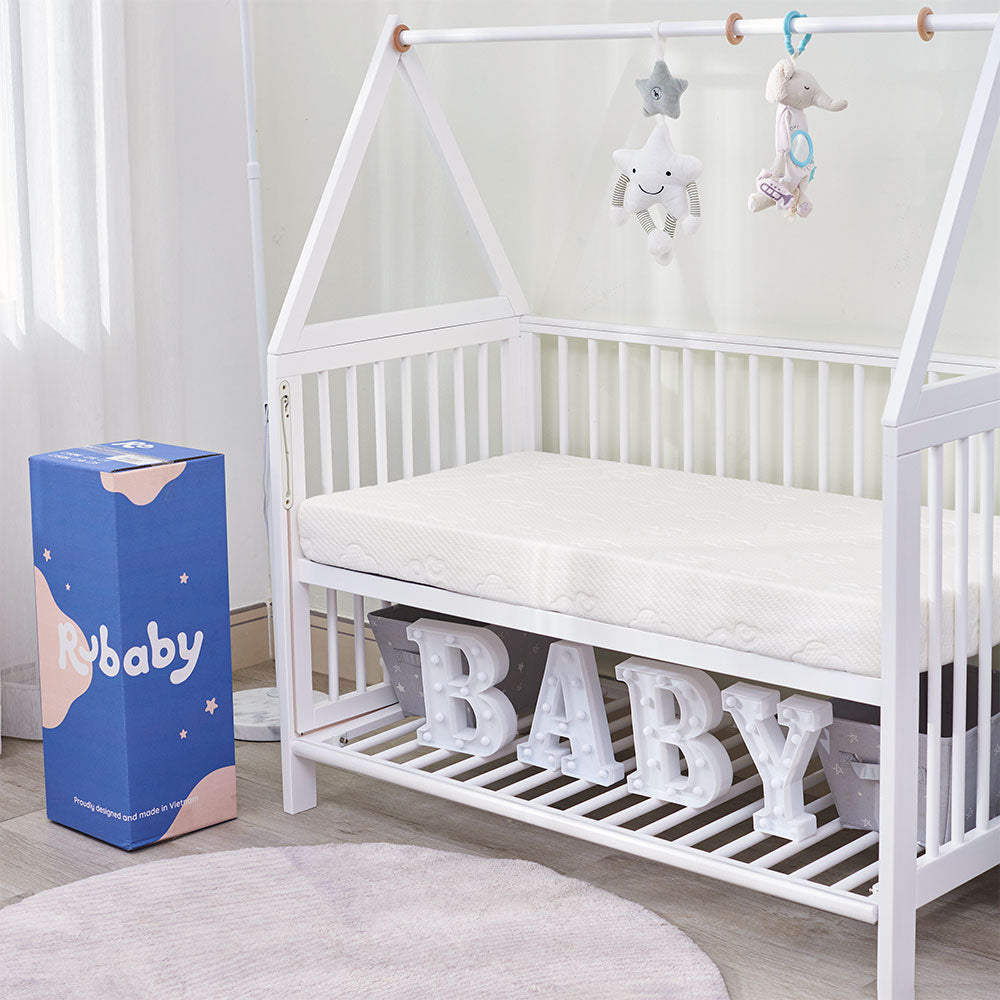
Choose by three criteria: a firm, flat surface, a size that snugly fits the crib with no gap wider than 2cm, and independently certified materials. Rubaby's baby mattress is 10cm thick, has surface-ventilated foam, a knitted bamboo-fiber cover certified OEKO-TEX® Standard 100, CertiPUR-US® certified foam, an anti-slip base layer, and a white cover for easy stain-spotting.

A pillow for a 1-2 year old should be about 3-4cm high — much lower than an adult pillow. At this age the neck curve is only beginning to form, so the pillow only needs to fill the small gap between head and mattress so the neck is not flexed. The Rubaby 1-2 year pillow is 297,000 VND.

From around 12 months, once your baby rolls and turns confidently in the cot. Before then a pillow is a loose soft item in the sleep space and adds risk without adding support. Start very low — about 3-4cm — and increase with age. Rubaby graduates pillows across four age bands from 1-2 up to 8-12 years.

Height and softness. A 5-7 year old has far narrower shoulders than an adult, so an adult pillow at 10-12cm pushes the neck forward all night. Pillows for this age band are typically 5-7cm and moderately soft. The Rubaby 5-7 year pillow is 424,000 VND.

Children aged 8-12 are close to adult body proportions, so they need a pillow around 7-9cm and can use an adult mattress at 7.5-8.0 firmness. The spine develops quickly at this stage, which makes a stable support surface worth getting right. Rubaby offers an 8-12 year children's pillow at 424,000 VND; for the mattress, the Ru9 Nest or Fit works.

A dual-sided baby mattress carries one product across two stages. The firmer side is for 0-1 year, supporting an immature spine and reducing the risk a soft surface poses before a baby can turn their own head. The softer side is for 1-3 years, once the skeleton has firmed up. You flip it at 12 months.

Common cot sizes in Vietnam are 60 x 120cm and 70 x 140cm. More important than the number is the fit: the gap between mattress and cot frame must not exceed 2cm, since a wider gap can trap a limb or a baby's face. Measure the internal dimensions of your cot before buying a mattress or sheets.

Usually around 2.5-3.5 years, but the signals matter more than age: the child climbs out of the cot, or the cot rail sits below their chest when standing. When you move them, keep the mattress low and use a guard rail or floor cushions for the first few weeks. A slim 10-15cm mattress suits this stage.

The Rubaby baby mattress is designed to cover the full 0-3 year span, matching the move to a bed — you flip to the softer side at 12 months. Replace sooner if there is a visible indentation, if the surface is no longer flat, or if liquid soaked into the core and could not be dried. It carries a 1-year warranty.

Rubaby by Ru9 covers four groups: a 10cm dual-sided baby mattress (firm side 0-1 year, softer side 1-3 years), the Peanut portable crib, pillows across six age bands from newborn to 12 years, and accessories including cooling mats, waterproof pads, cot sheets, muslin blankets, swaddles and burp cloths. Foam is CertiPUR-US®, textiles OEKO-TEX®.

A 5 year old can use a firm children's mattress or an adult mattress with firmness around 7.5-8.0, sized to the bed. Growing spines benefit from a consistently supportive surface. A slim 10-15cm model such as the Ru9 Fit or Nest suits this stage — easy to get in and out of, firm enough to keep the spine aligned.

CertiPUR-US® is an independent foam certification with six criteria: no ozone-depleting manufacturing, no PBDE, TDCPP or TCEP flame retardants, no mercury, lead or heavy metals, no formaldehyde, no phthalates, and VOC emissions below 0.5 ppm. Certified foam is re-tested randomly each year. Participating brands are listed publicly at certipur.us/directory.

OEKO-TEX® Standard 100 is an independent testing certification confirming that a textile contains no harmful substances above defined limits. Products are graded by class, with Class 1 — the strictest — reserved for items in direct contact with the skin of children under three. Ru9 and Rubaby textiles carry this certification.

Uncertified foam can contain formaldehyde, phthalates or PBDE flame retardants, which is why independent certification exists. CertiPUR-US® tests specifically for these and caps VOC emissions. The new-mattress smell itself is normal off-gassing that clears in 24-72 hours and is not a reliable indicator either way — check certification instead.

Ru9 states that all its foam is CertiPUR-US® certified, with textiles certified to OEKO-TEX®; details are published at ru9.vn/pages/certification. Certification is not universal in the Vietnamese market, particularly among marketplace sellers. Ask any brand to name the certificate holder and number rather than accepting a logo on a product page.

Check the public register rather than the logo. CertiPUR-US® lists every participating brand at certipur.us/directory, so you can search a brand name directly — Ru9 appears there. OEKO-TEX® has its own verification tool but no equivalent brand directory, so for textiles ask for the certificate number and the issuing institute.

Some conventional foam uses PBDE-class flame retardants, which is one of the substances CertiPUR-US® specifically prohibits. Vietnam does not mandate flame retardants in domestic mattresses the way some export markets do, so certified foam is the practical way to be sure. Ru9 foam carries CertiPUR-US® certification, which covers this.

Memory foam itself is generally suitable for allergy sufferers because dense closed foam offers less habitat for dust mites than cotton-filled or spring mattresses. The bigger factor is what sits on top. Use a washable mattress protector, wash bedding at 60°C every one to two weeks, and vacuum the surface periodically.

Vietnam does not require the mattress-specific flammability or labelling standards that apply in some export markets, so voluntary international certification is the main quality signal available to buyers. Look for CertiPUR-US® on foam and OEKO-TEX® Standard 100 on textiles, both independently tested, rather than relying on unverified domestic quality claims.

A bundle usually costs less than buying separately, but what to check is the policy attached, not just the price. The mattress in a bundle still gets the 100-night trial and its model warranty, but pillows, blankets and sheets have their own terms — many textile products carry no warranty. Ask which policy applies to each item in the bundle before committing.

Yes. The Sleep Match Quiz on ru9.vn asks about five questions covering weight, sleeping position, how hot you sleep and budget, then recommends a model. It sits on top of the 9-dimension consultation framework Ru9's Sleep Consultants use. For complicated cases — back pain, two people with different needs — talk to a consultant on Zalo instead.

Ru9 accepts bank transfer, international credit and debit cards, e-wallets, cash on delivery, and 0% interest instalments on credit cards from 22 banks over 3, 6, 9 or 12 months for orders from 3 million VND. Showrooms additionally offer a deposit to reserve stock — see the deposit and refund policy on ru9.vn.

Not required — you can walk in during opening hours. But if you want a detailed consultation based on your weight and sleeping position, or want to try a specific model, booking ahead by Zalo or hotline lets the showroom prepare and saves you waiting at weekends. Addresses for all three showrooms are at ru9.vn/pages/stores.

Official channels are the website ru9.vn, three showrooms in Ho Chi Minh City and Hanoi, the Zalo Official Account and Ru9's verified social media pages, plus official storefronts on Shopee, Lazada, TikTok Shop and Tiki. One important note: marketplace orders follow each platform's own policy and do not include the 100-night trial.

For a family sharing a bed, settle size before model: 1m8x2m is the minimum for two adults and a child. On model, the Ru9 Hybrid has pocket springs that support the mattress edge well — important with a child sleeping near the side; the Original Pro isolates motion better if your child is a light sleeper. Note that babies under 12 months should have their own flat sleep surface.

Yes, with the right construction. The Ru9 Hybrid suits a large weight difference best: individually pocketed springs compress zone by zone, so the heavier person does not create a hollow that pulls the lighter one in, and edge support keeps the sides from collapsing. If one of you has a disc problem, choose the Firm version and consider a separate topper on the lighter person's side.

Foam isolates motion better than springs, because memory foam absorbs force at the point of impact instead of transmitting it sideways. The Ru9 Original and Original Pro are the strongest choices in the range for this. The Hybrid uses individually pocketed springs, so it also limits transfer well compared with connected coils, but stays bouncier than foam.

Prioritise the protective layer over the mattress model. A waterproof sheet stops urine and saliva reaching the foam — liquid is the most common cause of a voided warranty. For bedding, tightly woven fabrics like Percale hold less hair than knits or brushed surfaces, and stand up to washing two or three times a month.

Twin newborns sharing need a surface that is evenly firm across its whole area, with no individual sinking. The 10cm Rubaby baby mattress, on its firm 0-1 year side, meets that. More important than size: each baby needs their own space, placed on their back, with no loose pillows or blankets around — and the mattress must fit the cot snugly with no gap over 2cm.

In Vietnam, certified-brand foam mattresses typically run 6–13 million VND for a 1.6m x 2m size. Under 3 million usually means low-density foam that sags within 2–3 years. Spread over an 8-year lifespan, a 9-million-VND mattress works out to about 3,000 VND per night — a more realistic comparison than the sticker price.

Ru9 mattresses range from 3,726,700 VND to about 14,690,000 VND depending on the line and size. Fit (10cm) from 3,726,700 VND, Nest (15cm) from 6,050,700 VND, Original from 8,743,000 VND, Air from 9,490,000 VND, Original Pro from 9,793,000 VND, Hybrid from 12,486,500 VND. Prices updated at ru9.vn/collections/nem.

On a 5-million budget, the Fit (10cm, firmness 7.0, from 3,726,700 VND) suits you if you're under 60kg or using a platform bed. If you need more thickness, the 15cm Nest from 6,050,700 VND is the next step up. Another option: keep your current mattress and add a Cloud Topper from 2,730,700 VND if the base is still solid.

On 10 million, three Ru9 options are in range: the Original (20–25cm, firmness 7.5, from 8,743,000 VND) for side sleepers, the Air (18cm, breathable, from 9,490,000 VND) for hot sleepers, and the Original Pro (25cm, 5 layers, 3-zone support, from 9,793,000 VND) for back pain or people over 80kg.

Depends on the lifespan. A mattress used for 7–10 years usually makes the price gap per night smaller than you'd think — 9 million VND over 8 years is about 3,000 VND a night. Cheap mattresses under 3 million usually use low-density foam that sags within 2–3 years, so the real cost per night can end up higher than a pricier mattress.

Ru9 offers 0% interest installments through credit cards from 22 banks, over 3, 6, 9, or 12 months, for orders from 3 million VND. Note: the interest rate is 0%, but banks charge an installment conversion fee, usually 3.5%–7% depending on the bank and term. Sign up on ru9.vn or in-store.

Vietnam's mattress industry discounts most heavily around three windows: end of the calendar year, Tet (Lunar New Year), and e-commerce "double days" like 9/9, 10/10, and 11/11. That said, if your current mattress is causing back pain, the cost of waiting a few more months usually outweighs the savings.

Not necessarily. Marketplace prices can be lower during certain promotions, but Ru9 only lists its Essential tier on Shopee and TikTok Shop — Premium lines like Original Pro and Hybrid sell only on the website and in showrooms. More importantly, the 100-night trial doesn't apply to marketplace orders.

Yes, if you understand the trade-off. Mattresses under 3 million VND typically use PU foam at 25-30 kg/m³, which starts sagging into a permanent hollow after 6-12 months, carries no material certification, and rarely comes with an enforceable warranty. It makes sense for temporary needs rather than the bed you sleep in every night.

Divide the mattress price by nights of use. A 9,793,000 VND mattress used over 10 years — matching its warranty period — works out to about 2,700 VND per night. This is a useful way to compare price tiers, since a 3-million-VND gap between two mattress lines is only a few hundred VND per night.

Babies aged 0-3 months sleep about 14-17 hours a day, and often 16-18 hours in the first weeks, in stretches of 2-4 hours. At 4-11 months it is 12-15 hours; at 1-2 years, 11-14 hours. About 70-80% of brain development happens in the first three years, and much of it during sleep.

Most babies can sleep in long stretches from around 4-6 months, once the stomach is large enough not to need continuous night feeds. Three things help: a consistent daily rhythm, putting the baby down drowsy but awake so they learn to settle themselves, and keeping the room dark and cool at 20-22°C.

Work through the list in order: hungry, wet nappy, too warm or too cold, then overtired. Crying at night is often the result of being awake too long, so try shortening the gaps between sleeps. A steady environment helps — dark room, 20-22°C, gentle white noise. If crying comes with fever or feeding refusal, see a doctor.

Most sleep training approaches recommend starting at 4-6 months, once a baby has a clear day-night rhythm and no longer needs continuous night feeds. There is no single correct method — what matters most is choosing an approach you can apply consistently. Sleep training is an option, not a requirement.

Sleep patterns shift by month. At 0-3 months babies sleep 14-17 hours across many short stretches with no clear day-night rhythm. At 4-6 months they take about three daytime naps, dropping to two by 6-9 months, and to a single afternoon nap from around 15-18 months. Awake windows lengthen from 45 minutes to 3-4 hours.

Wonder weeks are developmental leaps in a baby's perception and cognition, usually accompanied by disturbed sleep, clinginess and fussiness for one to two weeks. They are a sign the brain is processing new skills, not a sign you are doing something wrong. Keep the routine steady — these phases pass on their own.

Day-night confusion is normal in the first month because the circadian rhythm has not yet formed. To shift it: expose your baby to natural light and normal household sound during the day, and keep nights dark, quiet and low-interaction, even during feeds. The day-night rhythm usually settles from six to eight weeks.

Three things that realistically help: sleep when the baby sleeps, even for 20 minutes; split the night into shifts with your partner so each of you gets one unbroken block; and keep the room cool at 20-22°C. A postpartum body needs more recovery than usual. If low mood persists, speak to your doctor.

A topper is a 5-10cm layer placed on an existing mattress to change how it feels. Use one when the mattress is still firm underneath but too hard or lacking contour. On the Ru9 Original Pro the topper is structural: 5cm attached by zip, swappable between Medium and Firm within 100 nights, and replaceable on its own after 5-7 years instead of buying a whole new mattress.

No. A topper changes the surface but cannot fix the support underneath — if the core has sagged, the topper simply follows the hollow and your spine stays misaligned. Toppers work when the mattress is still firm but too hard. Note that Ru9 toppers carry a 1-year warranty, shorter than mattresses, because they take the wear directly.

Pillow height depends on sleeping position. Side sleepers need 10-14cm to fill the gap between shoulder and neck. Back sleepers need 8-10cm. Stomach sleepers need under 6cm, or no pillow at all. The test: lying in your usual position, your neck should line up with your spine, neither flexed nor extended.

A memory foam pillow helps if the neck pain comes from the wrong pillow height, because foam holds its shape through the night instead of flattening the way a fibre pillow does. What actually decides it is height matched to your sleeping position, not the material. If neck pain comes with arm numbness or lasts more than a few weeks, see a doctor.

Replace a pillow every one to two years, far sooner than a mattress. A simple test: fold it in half and let go — if it does not spring back to its original shape, it has lost its support. Old pillows also accumulate perspiration, skin cells and dust mites, so this is a hygiene question too.

In a Vietnamese summer, a thin breathable blanket is more comfortable than a thick one. The Cooling Blanket (from 1,047,200 VND) uses fibre that feels cool on contact, suited to rooms without air conditioning all night. The Eucalyptus Blanket (from 2,455,200 VND) is made from eucalyptus fibre, absorbs moisture strongly and stays naturally cool — good for night sweats.

For a hot, humid climate, choose Tencel or Percale. Tencel is made from wood fibre, absorbs moisture strongly and feels cool to the touch — good for night sweats. Percale is a plain even weave, the thinnest and most breathable of the three. Cotton sateen is softer and more lustrous but retains more heat, suiting air-conditioned rooms. Ru9 offers all three in its bedding range.

A Ru9 bedding set includes a fitted sheet with elastic, a duvet cover and pillowcases in the quantity matching your bed size. Sheets are cut to the exact height of each mattress model — which matters, because a shallow sheet pops off the corners of a 25cm mattress. When ordering, select by both mattress size and height.

A microfibre blanket uses synthetic or bamboo fibre for a soft, light feel, is machine washable and dries quickly — suited to Vietnam's humidity. A down blanket insulates far better at the same weight but is harder to clean, slow to dry and can trigger allergies. For Vietnamese weather, microfibre is the more practical choice.

IceFiber™ is a high thermal-conductivity fibre that feels cool when your skin meets the pillowcase surface. The mechanism is moving heat away from the skin faster than ordinary cotton, so the effect is most noticeable in the moment you put your head down. The Ru9 IceFiber™ pillowcase set is 791,120 VND.

The three most common sizes in Vietnam are 1.2m x 2m (single), 1.6m x 2m (standard double), and 1.8m x 2m (queen-wide). There's also 1.4m x 2m and 2m x 2.2m for larger rooms. Note that Vietnamese sizes don't match US Queen or King standards, so imported sheets often don't fit.

Choose 1.6m x 2m if your room is under 15m² or you sleep alone — this is Vietnam's standard double size. Choose 1.8m x 2m if two people share the bed and at least one weighs over 70kg, or if kids climb into bed. Each person should have at least 80cm of width.

For most adults, 20–25cm is the right range. Under 15cm only suits people under 60kg or a platform bed. Over 80kg, choose at least 20cm so the base layer doesn't fully compress. Ru9's range: Fit 10cm, Nest 15cm, Air 18cm, Original 20–25cm, Original Pro and Hybrid 25cm.

A 10cm mattress isn't too thin if used for the right purpose — people under 60kg, bunk beds, platform beds, or a spare mattress. What matters is foam density: cheap 25–30 kg/m³ foam sags within 6–12 months. Ru9's Fit uses 40 kg/m³ HR foam with a resilience rating of ≥55% per ASTM D3574, holding shape for 3–5 years.

A bunk bed mattress should be 10-15cm thick, because the safety rule is that the mattress surface must sit at least 12cm below the guard rail so a child cannot roll over it. Too thick and the rail stops doing its job. The Ru9 Fit (10cm) and Nest (15cm) fall in this range; measure your rail height before choosing.

Yes, but the slat gaps must be under 7cm. Wider gaps let the foam sag between the slats, creating permanent indentations and potentially voiding the warranty. If your bed has wide slats, the cheapest fix is placing a thin board or wire mesh over the slats before laying down the mattress.

A rolled mattress is vacuum-compressed and boxed; foam quality is identical to a flat mattress — only the packaging differs. Ru9's mattresses expand to about 90% right after unboxing and reach full shape within 2–3 days. Unbox within 30 days of receipt. Spring mattresses generally can't be rolled because of the spring structure.

Folding mattresses are less durable than single-piece ones at the fold lines themselves, because foam at a crease takes repeated bending stress and degrades earlier than the rest. What you get in return is flexibility — stored away during the day, carried with you when you move. For a bed you sleep in every night, a single-piece mattress lasts longer.

A 12m² room suits a 1.6m x 2m bed, leaving at least 60cm of walking space on three sides for closets and movement. For more space, choose a low platform bed with no legs and a thin 15cm mattress like the Nest — the room will feel noticeably larger than with a raised bed frame.

Placing a foam mattress directly on the floor isn't wrong, but it's risky in Vietnam's humid climate. Air can't circulate under the mattress, so moisture condenses and causes mold within months. If you must use the floor, stand the mattress up to air out weekly; a slatted bed frame is the better option.

No. A US Queen is 152 x 203cm; the closest Vietnamese size is 1m6 x 2m, which is 160 x 200cm — 8cm wider and 3cm shorter. A US King is 193 x 203cm against Vietnam's 1m8 x 2m at 180 x 200cm. Imported fitted sheets generally will not fit Vietnamese mattresses properly.

Usually not. Vietnamese sizes are metric (160 x 200cm, 180 x 200cm) while US and European sheets follow different dimensions, so fitted sheets either gape or will not stretch over the corners. Buy sheets locally, sized to both the width and the height of your mattress — a 25cm mattress needs deep-pocket sheets.

No. Box springs are designed for traditional innerspring mattresses. Foam needs a firm, even, well-ventilated base — a slatted frame with gaps under 7cm, or a solid platform. Putting foam on an old sagging box spring transfers that sag straight into the mattress and can void the warranty.

Yes — Ru9 makes custom-size mattresses for non-standard frames, folding beds, ship berths and children's cots. One important condition: custom-size mattresses are excluded from the 100-night trial unless they have a manufacturing defect. Measure the internal frame dimensions and confirm the spec with a consultant by Zalo or hotline before ordering.

80x200cm is a narrow single, commonly used for bunk beds, small rooms or an older person's bed. Within the Ru9 range, the 10cm Fit and 15cm Nest are the two best fits at this size. If 80x200cm is not listed as a standard option, this becomes a custom-size order — contact a consultant for a quote.

Yes. A baby mattress cut to bassinet or cot dimensions is a custom order Ru9 accepts, and you can order a matching waterproof pad so it fits snugly. The safety point matters more than the number: the gap between mattress and cot frame must not exceed 2cm. Measure the internal dimensions of the cot and send them to a consultant before ordering.

The Original Pro in 1m6x2m is vacuum-compressed and rolled into a carton, so it clears apartment lifts and narrow stairwells, but it is still a heavy package needing two people to carry. Exact box dimensions and weight vary by production batch — confirm with a consultant if you need to measure your entrance or lift beforehand.

IceFlow™ is Ru9's cooling sheet and pillowcase line. It uses high thermal-conductivity fibre that moves heat away from the skin faster than cotton — measurably 2-3°C cooler on contact — with added Spandex so it grips the mattress and resists pilling. The effect is strongest at the moment skin meets the surface.

Yes, and it is more comfortable than a cooling mat because it is a full fitted sheet, so it does not shift out of place or crease under your back. The IceFlow™ set is about 2-3°C cooler on skin contact, machine washable, and usable year-round rather than only in summer. If your back runs hot all night rather than only when you first lie down, combine it with an airflow solution in the mattress itself.

Yes, and try these in cost order before considering a new mattress. First, switch to IceFlow™, Tencel or Percale sheets. Second, replace a heavy duvet with a cooling or eucalyptus blanket. Third, add a heat-dispersing mattress protector. Only if your back still runs hot all night is a mattress with airflow construction, like the Ru9 Air, worth the spend.

A mattress protector is a thin quilted layer that sits on the mattress, blocking perspiration and dust, with a comfortable surface to sleep on directly. A waterproof sheet adds a membrane that stops liquid reaching the foam — essential with young children, pets or illness. If choosing one, choose waterproof: liquid is the most common reason warranties are voided.

Cheap plastic-membrane waterproof sheets do, because a sealed membrane blocks water vapour as well as liquid. Sheets using a breathable TPU membrane limit this: water cannot pass through but moisture vapour still escapes. When buying, ask specifically whether the membrane is PVC or TPU. For young children lying directly on it, add a cotton or muslin sheet on top.

A sleep mask makes a clear difference for daytime sleepers, anyone in a room that does not block light fully, and people travelling across time zones. Light suppresses melatonin, so blocking it completely helps you fall asleep faster. One thing to check when choosing: the mask should not press on the eyeballs — a design with eye cavities is more comfortable than a flat one pressed against the face.

Vietnam has a well-developed mattress market with both local manufacturers and importers. For foam mattresses, direct-to-consumer brands like Ru9 sell online with home delivery nationwide and showrooms in Ho Chi Minh City and Hanoi. Established names include Vua Nem (169 retail stores), Kymdan and Lien A for natural latex.

Most expats in Ho Chi Minh City buy from direct-to-consumer brands online, from multi-brand retailers like Vua Nem, or from furniture districts along Ngo Gia Tu street. Ru9 has a showroom in Ho Chi Minh City where you can test the full range, plus a 100-night home trial if you prefer to order online.

In Hanoi you can buy from multi-brand retailers such as Vua Nem, from latex specialists Kymdan and Lien A, or from direct-to-consumer foam brands. Ru9 has a Hanoi showroom and delivers nationwide, with a 100-night home trial on mattresses bought through its own channels. Showroom addresses are listed at ru9.vn/pages/stores.

Quality varies widely, so check certification rather than origin. Vietnam manufactures mattresses for export and several domestic brands hold independent certifications — CertiPUR-US® for foam and OEKO-TEX® for textiles. Ru9 foam holds CertiPUR-US® and its mattresses carry a 10-year warranty. Uncertified market foam under 3 million VND typically sags within two to three years.

Buying locally is almost always cheaper. International shipping for a mattress costs more than a good Vietnamese mattress, and Vietnamese bed frames use different dimensions from US and European standards, so an imported mattress may not fit your frame or your sheets. Local brands also design firmness for the climate and local body types.

Yes. Foam mattresses are vacuum-compressed and boxed, so they fit through narrow stairwells and lifts, and most Vietnamese brands deliver nationwide. Ru9 delivers across Vietnam, typically in 2-5 working days within Ho Chi Minh City and Hanoi. Allow 24-72 hours after unboxing for the mattress to fully expand before judging comfort.

Support in English varies by brand and is usually strongest at direct-to-consumer companies and showrooms in Ho Chi Minh City and Hanoi. Ru9 offers consultation by phone, Zalo and in showroom. If you are buying remotely, confirm before ordering that the trial and warranty terms can be explained to you in English.

Budget 6-13 million VND (roughly 240-520 USD) for a certified foam mattress in a 1m6 x 2m size. Below 3 million VND you are generally buying low-density foam that sags within two to three years. Ru9 mattresses run from 3,726,700 VND for the 10cm Fit to about 14,690,000 VND for the Hybrid.

Serviced apartments usually come furnished, so a topper is often the better buy — it changes the sleeping surface without replacing the landlord's mattress and moves with you. If you are furnishing the room yourself, a 15cm mattress like the Ru9 Nest suits platform beds and is easy to move through apartment lifts.

Most established Vietnamese brands accept international Visa and Mastercard through their online checkout, alongside domestic bank transfer, cash on delivery and e-wallets. Ru9 sells through its own Shopify storefront at ru9.vn, which supports international cards. If you are paying in person at a showroom, confirm card acceptance in advance.

Yes. Most Vietnamese mattress brands ship nationwide, including Da Nang, Nha Trang, Hai Phong and Can Tho, because vacuum-compressed foam mattresses ship as a single box. Ru9 delivers throughout Vietnam. Delivery to provinces outside Ho Chi Minh City and Hanoi takes longer than the usual 2-5 working days.

For a one to two year stay it is usually still worth buying. A 6 million VND mattress over 18 months costs about 11,000 VND per night, and poor sleep for that long is expensive in other ways. Choose a rolled 15cm model like the Ru9 Nest, which is easy to resell or move.

For rentals, choose a rolled mattress that moves with you. The Ru9 Fit (10cm, from 3,726,700 VND) is designed for exactly this: a wavy HR foam surface that channels heat out, antibacterial green tea essence built into the foam to limit odour and mould in poorly ventilated rooms, a machine-washable cover, and a non-slip silicone base for floor use.

Yes, if you buy a rolled foam mattress. These compress into a box for the original delivery, and while they cannot be re-compressed to the same degree at home, they are light enough to move by van and fit through most stairwells. Spring and hybrid mattresses are considerably harder to relocate.

For the first six months, yes — guidance is to room-share without bed-sharing, and a portable crib gives the baby a separate flat sleep surface right beside your bed for night feeds. It also folds for travel and visits to family. The Rubaby portable crib is 2,072,000 VND.

Act immediately: remove the cover and machine wash it, blot the foam dry with a towel — do not rub — then aim a fan directly at it for 12-24 hours. Never wash the foam core and never use a hot dryer. The best prevention is a waterproof cot sheet (from 161,700 VND) or a waterproof pad (from 395,100 VND), both machine washable.

For sleep, prepare: a firm flat cot mattress that fits snugly, two or three fitted sheets, a waterproof pad, two or three swaddles, a seasonal sleep sack and burp cloths. You do not need pillows, thick blankets or cot bumpers for a baby under 12 months. Buy few items, buy to safety standard, add later.

The most useful gifts are the everyday items parents run through constantly and rarely buy enough of: waterproof sheets, swaddles, muslin blankets and burp cloths. Rubaby stocks these from 159,200 VND, suitable individually or as a set. For a larger gift, a certified cot mattress or portable crib is genuinely used daily.

Yes. Rubaby is Ru9's sub-brand for infant and child sleep, operating at rubaby.vn. It applies the same material standards as Ru9CertiPUR-US® certified foam and OEKO-TEX® certified textiles — with a product range and safety guidance developed specifically for newborns and young children.

Rubaby by Ru9 sells baby sleep products online at rubaby.vn with nationwide delivery, and Ru9 has showrooms in Ho Chi Minh City and Hanoi. Whatever brand you choose, look for CertiPUR-US® on foam and OEKO-TEX® Standard 100 Class 1 on textiles — the strictest grade for items touching a young child's skin.

The Nest is 15cm at 8.0 firmness, two layers of Contour/HR foam over a PU base — firm, straightforward support, accessible price. The Original is 20-25cm at 7.5, adding a cooling gel memory foam layer so it contours closely and isolates motion better. Choose the Nest if you like a firm feel; choose the Original if you sleep on your side or share the bed with someone who turns often.

The Original is 20-25cm with three foam layers, cooling gel memory foam and a fixed 7.5 firmness. The Original Pro is 25cm with five layers, Graphene Memory Foam for active heat dissipation, and Contour 3-Zone support across shoulder, back and legs. Its 5cm comfort topper unzips — swap firmness within 100 nights, replace just the topper after 5-7 years.

Choose the Air if heat is the main problem. Its AirCell foam™ core moves 4.58 times more air than standard foam (2,215.11 L/d·m²·min), under an IceFiber cover that cools on contact. Choose the Original Pro if you run hot and have back pain — Graphene Memory Foam handles heat well, plus you get three-zone support and a Firm option the Air does not offer.

Both are 25cm and both come in Medium and Firm with a swappable Comfort Top. The Original Pro is all foam — closer contouring and almost complete motion isolation. The Hybrid uses individually pocketed springs underneath — bouncier, more breathable, better edge support, and a better fit for anyone over 90kg. If you like a hotel feel, choose the Hybrid.

Six models. The Fit (10cm, firmness 7.0) suits small rooms and tight budgets. The Nest (15cm, 8.0) is a firm entry point. The Original (20-25cm, 7.5) adds cooling gel memory foam for contouring. The Air (18cm, 7.5) is built for hot sleepers. The Original Pro (25cm) adds three-zone support. The Hybrid (25cm) adds pocket springs.

The Original Lite is the Essential version of the Original line — 20cm tall, memory foam that contours to the body, suited to people between 60 and 90kg. Compared with the 25cm Original it is thinner, has fewer layers and costs less, but still carries a 10-year warranty. Choose the Lite if you want the memory foam feel at a more accessible price.

The Fit is 10cm at 7.0 firmness, using 40 kg/m³ HR foam with a wavy surface that channels heat out, antibacterial green tea essence and a non-slip base — it can go straight on the floor. The Nest is 15cm at 8.0, firmer and better supporting for anyone over 60kg. Under 60kg, or if you need to store it away, choose the Fit.

The Mate topper folds away, suiting anyone who needs to store it during the day or carry it when moving. The Flow topper ships rolled, is thicker, and stays fixed on an existing mattress. The Mây topper leans toward plushness, adding a soft layer over a mattress that is too firm. Note the warranties differ: Mate and Flow carry 1 year, the Mây topper has none.

The Hybrid Firm at 9.0 is the firmest in the Ru9 range, because pocket springs resist compression better than foam alone. Next is the Original Pro Firm at 8.5 with three-zone support, then the Nest at 8.0. If you are over 90kg, or used to traditional hard Vietnamese mattresses, start with one of the two Firm options.

Plushness is how the surface feels the moment you lie down. Support is whether the mattress holds your spine aligned across 6-8 hours. They are independent — a mattress can be both plush and supportive, or plush while letting your lower back sag. Prioritise support first, then adjust the feel with a comfort layer or topper.

The Niu uses Graphene memory foam — close contouring with active heat dissipation, for people who like sinking in. The Wave has a contoured profile with two different heights so you pick loft by sleeping position. The Align is an ergonomic cervical-support pillow shaped for a specific position. For persistent neck and shoulder pain, Align or Wave beat the Niu.

An ergonomic pillow is shaped to the anatomy of the neck and shoulders rather than being a uniform block. It holds the cervical spine in its natural curve instead of leaving the neck flexed or extended for hours. It suits people with neck and shoulder pain, heavy desk workers, and side sleepers who need the head-to-shoulder gap filled.

For neck and shoulder pain, the Align pillow is the first choice — an ergonomic design supporting the cervical vertebrae for a specific sleeping position. The Wave is the alternative if you want to pick your own height, since its two ends differ in loft. What actually decides it is height matched to your head-to-shoulder distance, not the material.

A body pillow keeps side sleepers aligned. Held between the knees, it stops the upper leg sliding forward, which would rotate the pelvis and twist the lower back. That is why it is commonly recommended in pregnancy and for hip pain. The Ru9 body pillow is 20cm high with a 1-year warranty against compression beyond 2cm.

People with acid reflux should raise the whole upper body rather than just the head — propping the head alone bends the neck without reducing reflux. What works is elevating the shoulders and upper back together, or raising the head of the bed by 15-20cm. If you need a pillow that keeps the neck properly supported while doing that, the Align suits. Persistent reflux warrants a gastroenterology consultation.

Sometimes, but a pillow is not a treatment. Snoring usually comes from airway narrowing when lying on your back; a pillow that holds the neck in its natural curve and encourages side sleeping can reduce it. For reflux, raising the whole upper body works — raising only the head bends the neck without helping. Persistent snoring with breathing pauses needs a doctor.

There's no single best brand for everyone — different brands suit different needs. Vua Nem is strong on store coverage, Kymdan is strong on natural rubber, and Ru9 focuses on foam mattresses designed for Vietnamese body types, with CertiPUR-US® certification and a 100-night trial.

Ru9 is a Vietnamese sleep brand that researches and manufactures foam mattresses, pillows, toppers, and bedding designed for Vietnamese body types. In 2019, the Original became the first bed-in-a-box foam mattress in Vietnam. Its foam is CertiPUR-US® certified and fabrics are OEKO-TEX® certified. Ru9 sells directly via ru9.vn and 3 showrooms in Ho Chi Minh City and Hanoi.

Judged by verifiable criteria: foam is CertiPUR-US® certified with VOC emissions under 0.5 ppm and annual random re-testing, firmness and layer structure are published for each line, there's a 100-night trial, and the return rate is under 3%. Warranty by line: 10 years for Original Pro and Hybrid, 5 years for Nest, 1 year for toppers.

Two different models. Vua Nem is a multi-brand retailer with 169 stores nationwide — strong if you want to see many brands in one place and have a store nearby. Ru9 sells its own products directly, focuses on foam designed for Vietnamese body types, offers a 100-night trial, but has showrooms in only two cities.

They differ in material and price. Kymdan uses natural rubber, carries a 15-year warranty, costs around 28–38 million VND, and is very bouncy and durable. Ru9 makes multi-layer foam mattresses certified CertiPUR-US®, priced 3.7–14.7 million VND, hugs the body better, and offers a 100-night trial. Latex suits people who like bounce; foam suits side sleepers.

Goodnight belongs to Vua Nem, priced around 2.58-5.95 million VND and aimed at younger first-time buyers through TikTok Shop. Ru9 sits at 3.7-14.7 million VND with CertiPUR-US® certification, published technical specifications and a 10-year warranty. If your budget is under 6 million VND, compare Goodnight against the Ru9 Nest or Fit.

Lien A has 37 years in the business, exports to 48 countries, spans a wide 7-45 million VND range and is strongest in natural latex. Ru9 is a direct-to-consumer brand focused on multi-layer foam for Vietnamese body types, with a 100-night home trial. Choose Lien A for latex and long track record; choose Ru9 if you want to test at home before committing.

Both are direct-to-consumer foam brands in Vietnam. Nooz leans toward youthful design and sells mainly through marketplaces, priced around 4-8 million VND. Ru9 publishes firmness ratings and layer construction for every model, holds CertiPUR-US® certification, and offers a 100-night trial with a 10-year warranty. Compare both specification sheets before deciding.

A locally-made mattress isn't inherently worse — what matters is material certification and published specs. Domestically made mattresses have the advantage of being designed for Vietnamese body types and climate, cost less since there's no import duty, and warranties are easier to enforce. Check for CertiPUR-US® or OEKO-TEX® rather than country of origin.

Vietnamese foam brands worth considering include Ru9, Nooz, Goodnight and the foam range from Vua Nem. Compare them on four points: whether they hold CertiPUR-US® certification, whether firmness and layer construction are published, the warranty length and its specific sagging threshold, and whether a home sleep trial is offered.

Ru9 reports a return rate under 3% and an NPS of 4.5/5, with over 30,000 five-star reviews across the brand. Reviews are collected at ru9.vn/pages/danh-gia. When reading mattress reviews, prioritize ones written after at least a month of use — first-week impressions don't reflect durability.

The main risk isn't price but the lack of verifiable information: unclear foam density, no material certification, and a warranty that's hard to enforce once the seller disappears. If you still buy, ask for the foam density spec and CertiPUR-US® or OEKO-TEX® certification — a serious seller will be able to provide it.

Ru9 is a Vietnamese company, founded in Vietnam in 2017 and headquartered in Ho Chi Minh City. Its mattresses are designed for Vietnamese body types and climate rather than imported to a generic international spec. The foam carries CertiPUR-US® certification and textiles carry OEKO-TEX®, both independent international standards.

Ru9 was founded by Trang Dang, who serves as CEO. She has appeared on Shark Tank Vietnam and been profiled by Vietcetera and CafeF. The company was founded in 2017 as a direct-to-consumer sleep brand, applying sleep science to products designed specifically for Vietnamese body types rather than reselling imported designs.

Yes. Ru9 is the closest Vietnamese equivalent to the Casper model: it sells its own foam mattresses direct, ships them vacuum-compressed in a box, and offers a 100-night home trial. Its Original model was the first foam bed-in-a-box in Vietnam, launched in 2019. Nooz runs a similar direct model but sells mainly through marketplaces.

Ru9 offers a 100-night home trial on mattresses bought through ru9.vn, its three showrooms and official channels — uncommon in Vietnam, where most retailers offer showroom testing only. It excludes marketplace purchases through Shopee, Lazada, TikTok Shop and Tiki, which follow each platform's own return policy instead.

Vietnam's mattress market was valued at roughly 359.5 million USD in 2025, growing at a compound annual rate of about 6.47%. Memory foam accounts for approximately 33.95% of the market. Around 90% of Vietnamese buyers begin their mattress research online, which makes digital presence the primary battleground in the category.

Generally yes, because you avoid import duty and international freight. A certified Vietnamese foam mattress in a 1m6 x 2m size runs 6-13 million VND, while comparable imported brands often start well above that. Certification matters more than origin — check for CertiPUR-US® or OEKO-TEX® rather than assuming imported means better.

People with back pain usually suit a medium-firm to firm mattress (firmness 8.0–8.5) with zoned support, not a board-hard mattress or an overly soft one. The Original Pro has 5 foam layers with 3-zone support for the head, torso, and legs, 25cm thick, with a Medium (7.5–8) and a firmer 8.5 version.

Possibly. A telltale sign is pain right after waking that eases within 30–60 minutes of moving around, meaning the spine was misaligned all night. If the pain lasts all day or radiates down the legs, the cause is more likely something other than the mattress, and you should see a musculoskeletal specialist.

People with a herniated disc usually suit medium-firm (firmness 8.0–8.5), not board-hard. A surface that's too firm concentrates pressure on the vertebrae; too soft lets the lower back sag. The Original Pro Firm and Hybrid Firm fall in this range. Check with your treating doctor before switching mattresses.

Start with the pillow. Waking up with neck and shoulder pain is usually caused by the wrong pillow height — the neck bends or arches all night — and a new pillow is far cheaper than a new mattress. If the right-height pillow doesn't fix it after 2–3 weeks, consider the mattress, especially if it's over 7 years old.

The mattress determines whether your spine stays aligned all night. A night's sleep has 4–6 cycles of 90–110 minutes each. The wrong firmness makes you shift position more, and each shift is a micro-awakening that cuts a cycle short. The result: enough hours in bed, but no real recovery.

Feeling tired despite enough hours usually comes from fragmented sleep, not too few hours — a night needs 4–6 complete cycles of 90–110 minutes each. Three common causes: the wrong sleep surface making you shift often, a room that's too hot, or a sleep breathing disorder. If mattress and temperature are already optimized with no improvement, see a sleep specialist.

People with spinal bone spurs generally do better on a medium-firm mattress with zoned support, which holds the natural curve of the back rather than forcing the spine perfectly flat. Firmness of 8.0-8.5 is a sensible starting range — the Ru9 Original Pro Firm or Hybrid Firm. Consult a musculoskeletal specialist first.

Older adults usually need two things at once: firm enough support for the spine, and enough cushioning to ease pressure on the hip and shoulder joints. Firmness 8.0–8.5 with zoned support covers both. A 25cm mattress like the Original Pro or Hybrid is also easier to sit up from than a thin one placed on the floor.

From the second trimester, expectant mothers mostly sleep on their left side and need a surface soft enough for the shoulders and hips to sink in while the lower back stays supported — firmness around 7.5. Ru9's Original (7.5) or Hybrid Medium (8.0) suit this. A body pillow between the knees helps ease pressure on the hip joints.

Yes. A mattress that is too firm will not let the shoulders and hips sink in, so the lumbar curve is left unsupported and the back muscles hold position all night — you wake stiff and aching across the lower back. If you are not ready to replace the mattress, a 5-10cm topper such as the Mây topper or the Fit is the cheapest fix.

A hot back usually comes from memory foam retaining heat combined with sheets that trap moisture. Work through it in cost order: switch to breathable Tencel or Percale sheets first, and only then consider a new mattress. The Ru9 Air uses two cooling layers — an IceFiber cover that drops skin temperature on contact, over an AirCell foam™ core with 4.58 times the airflow, moving heat out through the night.

The ideal bedroom temperature is 18-22°C. Your core temperature needs to drop by about 1°C to fall asleep, so a room that is too warm makes it harder to drop off and more likely you wake during the night. In Vietnam's climate, running air conditioning at 25-26°C with breathable sheets like Tencel is usually easier to sustain than cooling the room deeply.

Foam itself does not cause allergies, but dust mites accumulating in the mattress and bedding are a common trigger. Dense foam offers less habitat for mites than a compressed cotton mattress. The most effective controls are a washable mattress protector, washing bedding at 60°C every one to two weeks, and vacuuming the mattress surface regularly.

A mattress is rarely the root cause of chronic insomnia, but it can sustain the cycle. The wrong surface makes you turn and wake repeatedly, which makes you anxious about sleeping — and that anxiety is what prolongs insomnia. If it has lasted more than three months, see a specialist.

Research generally favours medium-firm over very firm for lower back pain. A surface that is too hard concentrates pressure at the shoulders and hips and leaves the lumbar curve unsupported; one that is too soft lets the hips sink and the spine bow. Around 8.0-8.5 on a 10-point scale is a sensible starting range.

A foam mattress should be replaced after 7–10 years. But time isn't the only factor — replace it sooner if you see a clear body-shaped indentation, wake up with back pain that eases after moving around, or sleep better elsewhere than at home. These three signs are more reliable than the number of years.

Never wash the foam core — water soaking in is very hard to dry and causes mold from the inside. Ru9's mattress cover has a zipper; remove and machine-wash on a gentle cycle under 30°C. For the mattress body: vacuum the surface every 1–2 months, spot-clean stains with a damp cloth, then blot dry immediately. A mattress protector is the most effective prevention.

Act within minutes. Blot — don't rub — with a dry towel to absorb as much liquid as possible, then aim a fan directly at the wet area for 12–24 hours. Don't use a hot dryer, which deforms the foam. Note: a mattress exposed to liquid may no longer be covered by warranty, making a waterproof protector a worthwhile investment.

A small patch of surface mould can be treated by wiping with diluted alcohol and drying completely with a fan. If the mould has reached the foam core — recognisable by a damp, musty smell that persists after drying — replace the mattress, because mould spores inside foam cannot be removed and can irritate the airways.

Do not put foam in harsh direct sun. UV and high heat turn foam yellow, brittle and less resilient. To dry it or remove damp, stand the mattress upright in a ventilated room with a fan, or in indirect sunlight for no more than an hour. In a humid climate, standing it up monthly to air the underside is enough.

Wash bed sheets every one to two weeks. If you sleep with air conditioning and perspire little, two weeks is reasonable; if you sweat heavily, sleep with a pet, or it is the hot season, wash weekly. Washing at 60°C kills dust mites — which is why sheet washing matters most for allergy sufferers.

Four clearest signs: a body-shaped indentation remains after you get up, waking with back pain that gradually eases with movement, sleeping better at a hotel than at home, and the mattress is over 8 years old. Two or more of these signs mean it's time to replace it.

A multi-layer foam mattress has different top and bottom surfaces, so it can't be flipped — flipping it means sleeping on the hard base layer. But rotate it head-to-foot 180 degrees every 3–6 months to distribute pressure points evenly. A single-layer, uniform mattress can be flipped; check each line's instructions.

An old mattress should not go into general waste, since foam and springs take a very long time to break down. Some moving and second-hand dealers will collect mattresses, and charities accept ones that are clean and intact. Ru9 runs a community responsibility programme at ru9.vn/pages/trach-nhiem-cong-dong-csr.

Yes — it is a small spend that protects a large one. A protector stops perspiration, liquid and dust mites reaching the foam, and liquid is the most common reason a mattress warranty is voided. Ru9 offers the Nest cover from 899,000 VND and the Original cover from 1,099,000 VND, both machine washable.

Put the box beside the bed before opening it, because the mattress expands immediately and is hard to move afterwards. Cut the outer wrap, position the roll where it will live, then slit the vacuum bag — use the seal cutter supplied in the box and cut shallow so you do not score the foam. It reaches about 90% immediately and full form in 2-3 days.

Do not wash a foam core — water soaks in, is very hard to dry, and grows mould from inside. For a stain on the core: spot-clean with a barely damp cloth and a little neutral detergent, blot dry immediately with a dry towel, then aim a fan at it until completely dry. The pillowcase comes off and machine washes normally. An inner liner helps keep dirt off the core.

Yes, Ru9 blankets are machine washable. A sensible frequency is every two to four weeks for daily use, sooner if you perspire heavily or sleep with a pet. Use a gentle cycle, cool or warm water below 40°C, and air dry rather than tumble dry so the fibres do not shrink and stay soft. Blankets are not covered by warranty.

Tencel creases noticeably less than cotton, because Tencel fibre has more elasticity and a smoother surface so it holds folds less. On dust it is the opposite — that smooth surface picks up less dust and hair than loosely woven cotton. The thing to watch with Tencel is washing in cool water and avoiding fabric softener, since the softening coating reduces its moisture absorption.

Measure three numbers: mattress width, length and height — height is the one most often forgotten. Sheets are cut to the exact depth of each model, so a sheet made for a 15cm mattress pops off the corners of a 25cm one. Measure the mattress itself, not the bed frame. Ru9 mattresses run from 10cm to 25cm depending on model, so choose sheets by both size and height.

Airflow is the main defence. Use a slatted frame rather than the floor, stand the mattress upright monthly to dry the underside, and run a dehumidifier or air conditioning in the rainy season. Use a washable protector to keep perspiration out of the foam. Never wet-clean a foam mattress — trapped water grows mould from inside.

Dust mites feed on skin cells and thrive in humidity above 50%, which describes most of Vietnam year-round. Control them by washing bedding at 60°C every one to two weeks, using a washable mattress protector, vacuuming the mattress surface monthly, and running air conditioning or a dehumidifier to keep bedroom humidity down.

Layer the solutions. Use breathable bedding — Tencel or Percale rather than sateen — and a mattress with airflow construction such as the Ru9 Air. Keep the room at 20-22°C where possible, use a fan for air movement rather than cold air alone, and shower before bed to lower your core temperature.